Native plants are great for Eastern Washington.
But does that mean every native plant is a good choice around your home, especially during wildfire season? Not necessarily.
Most homeowners don’t think about this when choosing plants. We usually ask whether a plant looks good, survives the summer, or needs a lot of water. But in fire-prone parts of Eastern Washington, there’s another question worth asking: How will this landscape behave if a wildfire gets close?
With thoughtful fire-resistant landscaping in Washington, you can create an attractive, water-conscious yard, support native plants, and reduce some of the fuel that can help wildfire move toward your home.
The key is understanding what makes a landscape more resistant to ignition and fire spread—and realizing that no plant is completely fireproof.
Understanding Fire-Resistant Landscaping Washington
Fire-resistant landscaping is less about finding a magic list of plants and more about designing your yard to reduce available fuel and interrupt the path fire could take toward your home.
That means thinking about:
- What you plant
- Where you plant it
- How closely plants are spaced
- How much dead vegetation is present
- What materials you use around the house
- How you maintain the landscape
- How vegetation connects from the yard to the structure
And there’s an important distinction here:
Fire-resistant does not mean fireproof.
Under the right conditions, any vegetation can burn.
The goal is to make it harder for fire to move continuously through your landscape and reach your home.
Why Fire-Resistant Landscaping Matters in Eastern Washington
Eastern Washington presents some very different landscaping conditions from western Washington.
Summers can be hot and dry, and grasses and other vegetation can become extremely dry. In areas near wildland vegetation, a fire can potentially move from natural areas into residential landscapes.
That’s why Washington DNR provides a specific Fire-Resistant Plants for Eastern Washington guide rather than treating every part of the state the same way. The guide was developed specifically to help homeowners select plants and design landscapes suited to Eastern Washington conditions.
For homeowners, the question isn’t simply:
“Which plants should I grow?”
It’s:
“How can I design my entire yard so there is less continuous fuel around my home?”
That’s where defensible space comes in.
Defensible space landscaping is about creating an area around your home where vegetation and other combustible materials are managed to reduce the intensity and spread of wildfire.
WSU commonly describes three landscape zones around a structure:
- 0–5 feet: The area immediately surrounding the home. Keep this zone as low-fuel as practical.
- 5–30 feet: Use spacing, low-flammability vegetation, hardscape, and other fuel breaks to reduce fire spread.
- 30–100 feet or more: Reduce dense vegetation and accumulated fuels where appropriate for the property.
The exact distances and treatments can vary with the home, construction, surrounding vegetation, slope, and local conditions.
Think of these zones as a transition.
The closer you get to your house, the more careful you should be about combustible vegetation and materials.
Wildfire-Resistant Native Plants that Contribute to Fire-Conscious Landscape
Eastern Washington has plenty of native plants that can contribute to a fire-conscious landscape when they’re appropriate for the site and properly placed and maintained.
Washington DNR’s Eastern Washington guide specifically focuses on plants that are likely to thrive in the region and have been identified in fire-resistant plant resources.
Some examples include:
-
Serviceberry
Serviceberry (Amelanchier alnifolia) is a deciduous native shrub that can work well in appropriate Eastern Washington landscapes.
Its broad leaves and deciduous growth habit are characteristics worth considering in a fire-resistant planting.
-
Mock Orange
Mock orange (Philadelphus lewisii) is another native shrub used in Washington landscapes.
WSU Extension includes mock orange among its fire-resistant plant selections.
-
Red-Flowering Currant
Red-flowering currant (Ribes sanguineum) is a native shrub with attractive spring flowers.
Currants are also included among the types of plants identified by WSU Extension as suitable examples for fire-resistant landscapes.
-
Woods Rose
Woods rose (Rosa woodsii) can provide flowers and wildlife value while fitting into certain native landscape designs.
As with any plant, it should be matched to the site’s moisture, soil, sunlight, and space.
-
Common Snowberry
Common snowberry (Symphoricarpos albus) is another native shrub that can be considered where site conditions are appropriate.
Its deciduous nature and landscape usefulness make it worth considering in a carefully designed planting.
-
Arrowleaf Balsamroot
Arrowleaf balsamroot (Balsamorhiza sagittata) is a familiar Eastern Washington native perennial and an excellent example of how fire-conscious landscaping doesn’t have to mean giving up flowers.
WDFW includes balsamroot among Eastern Washington native plants, while regional WSU resources identify it among fire-resistant landscape plants.
-
Buckwheats
Several buckwheat (Eriogonum) species are native to Eastern Washington and can add flowers and texture to a landscape.
Examples include short-stem buckwheat and James buckwheat, both included in WDFW’s Eastern Washington native plant list.
-
Blue Flax
Blue flax (Linum lewisii) can add seasonal color without turning your landscape into another high-maintenance lawn.
It is also included in WSU’s regional fire-resistant plant resources.
-
Penstemons
Several Penstemon species can work in Eastern Washington native plantings.
Their suitability depends on the species and site, but they can add flowers and seasonal interest to a fire-conscious native landscape.
-
Woolly Sunflower and Globe Mallow
Woolly sunflower (Eriophyllum lanatum) and globe mallow (Sphaeralcea spp.) are additional examples of native flowering plants that can fit into appropriate Eastern Washington designs.
The important word here is appropriate.
None of these plants should be treated as a guarantee against wildfire. Plant characteristics, placement, spacing, irrigation, maintenance, weather, and surrounding fuels all matter.
Plant Placement Can Matter as Much as Plant Choice
Imagine planting a relatively low-flammability shrub right next to another shrub, then connecting that shrub to a tree, a fence, and eventually your house.
You’ve created a pathway.
That’s called fuel continuity.
A fire doesn’t necessarily care that each individual plant was selected from a “fire-resistant” list.
If vegetation forms a continuous connection, fire can potentially move through it.
That’s why good defensible space landscaping uses separation.
You might create breaks with:
- Gravel
- Paths
- Patios
- Stone
- Walls
- Carefully maintained open areas
- Proper spacing between plant groups
DNR specifically recommends materials such as gravel, stone walls, pathways, and other hardscape elements to break up fuel continuity.
The result can actually make a yard more interesting.
You don’t have one giant planting bed.
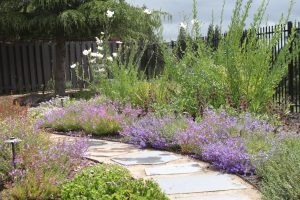
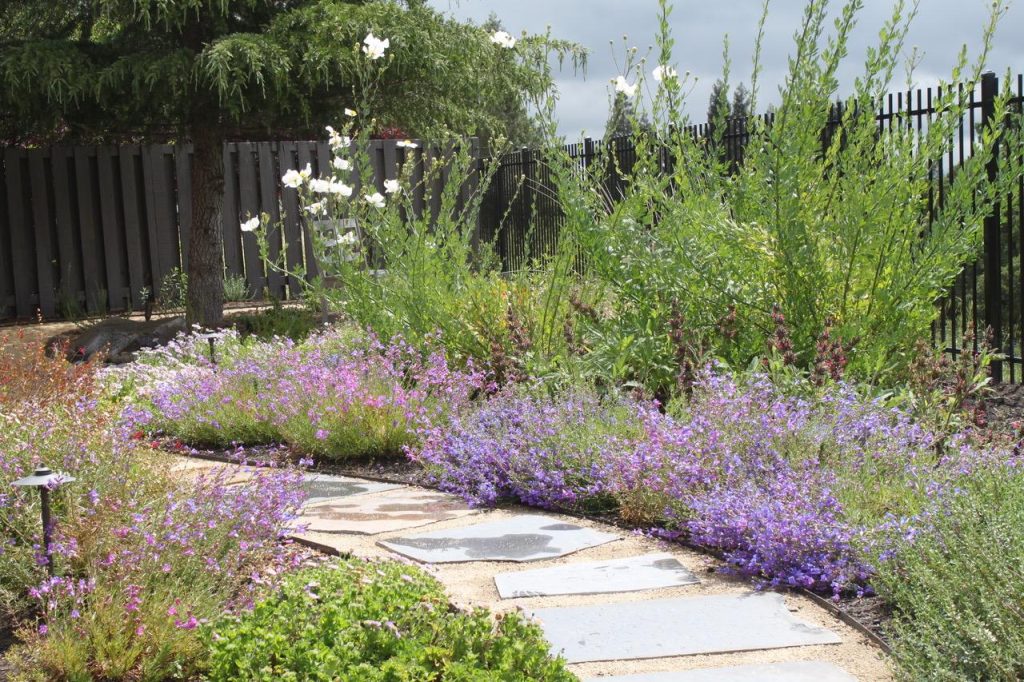
You have a series of connected but separated landscape areas.
Firewise Landscaping Tips for a Drought-Tolerant Yard
A drought-tolerant, fire-safe yard can make a lot of sense in Eastern Washington because water conservation and wildfire-conscious design often overlap.
But don’t assume drought-tolerant automatically means fire-resistant.
Some very drought-adapted plants can still contain dry, fine, or resinous material that burns readily.
Instead, combine water-wise design with fire-conscious practices.
-
Keep vegetation away from structures
Avoid allowing shrubs, trees, vines, and other vegetation to directly contact the house.
-
Break up plant groupings
Avoid creating continuous walls of vegetation.
-
Remove dead material
Dead leaves, branches, grasses, and other dry material can add fuel.
-
Keep plants maintained
Prune appropriately and prevent vegetation from becoming excessively dense.
-
Think carefully about mulch
Especially close to structures, consider less-flammable materials such as gravel or decorative rock.
-
Manage dry grasses
Dry grasses can become significant wildfire fuel. Keep them appropriately maintained, particularly where they could connect other vegetation.
-
Keep irrigation functional
Water isn’t a substitute for good design, but keeping plants adequately hydrated during the fire season can help maintain higher moisture levels in vegetation.
WSU emphasizes that maintenance, watering, pruning, and cleanup all affect whether vegetation ignites.
Maintenance Is Part of Fire-Resistant Landscaping
Here’s something easy to overlook:
A fire-resistant landscape can become less fire-resistant if you stop maintaining it.
- Plants grow.
- Branches die.
- Leaves accumulate.
- Grasses dry out.
- Weeds appear.
- Mulch becomes dry.
And a landscape that was carefully designed five years ago may not have the same fuel structure today.
Regular maintenance should include:
- Removing dead vegetation
- Controlling invasive weeds
- Pruning where appropriate
- Maintaining plant spacing
- Removing accumulated debris
- Keeping vegetation away from structures
- Managing dry grasses
- Checking irrigation systems
WDFW also recommends continuing to manage invasive weeds after planting and notes that wildflower meadows may need mowing in late summer or fall where wildfire risk makes keeping brush levels under control important.
WDFW also recommends continuing to manage invasive weeds after planting and notes that wildflower meadows may need mowing in late summer or fall where wildfire risk makes keeping brush levels under control important.
This is another reason to think of fire-resistant landscaping as a landscape management strategy, not simply a plant-shopping list.
You Don’t Have to Choose Between Fire Safety and a Beautiful Yard
Some homeowners hear “defensible space” and imagine removing everything green around the house.
That’s not the goal.
A well-designed fire-conscious landscape can still include:
- Native wildflowers
- Shrubs
- Small trees
- Ground covers
- Pathways
- Rock gardens
- Patios
- Seating areas
- Wildlife-friendly plantings
- Seasonal color
The difference is how those elements are arranged.
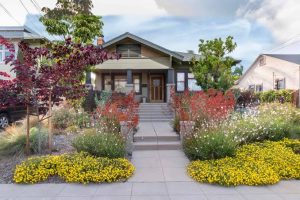
You can create attractive planting areas while leaving strategic breaks between vegetation.
You can use native plants while avoiding dense fuel connections.
Conclusion
Native plants can be an important part of fire-resistant landscaping in Washington, especially when they’re selected for local conditions and incorporated into a thoughtful landscape design.
But don’t fall into the trap of thinking that choosing a “fire-resistant” plant automatically makes your yard fire-safe.
The bigger picture matters.
Plant selection, defensible space, spacing, fuel breaks, irrigation, and ongoing maintenance all work together.
At Native Plant Landscaping & Restoration, we look at native landscaping from an ecological and site-specific perspective. That means considering the plants, soil, water, maintenance needs, and surrounding conditions—not simply choosing plants from a list.