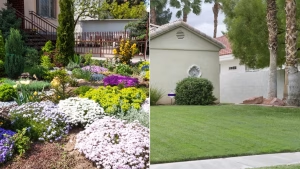
If you have ever imagined that placing some gravel and four cacti can make a fresh green yard and turn your area into a moon crater, then forget it.
Here we actually need to talk about swapping thirsty turf grass for native and drought-adapted plants that are exactly built for where you live. Honestly, if you are living in Eastern Washington, then we are sure that your yard must be fighting an uphill battle against the climate this whole time.
One week your green grass looks beautiful. And the other week, it was dry and rough.
And then comes the water bill. That’s where the concept of xeriscaping starts to sound attractive. Instead of having a large area with turf and dry plants, you can simply replace them with native, drought-tolerant plants, mulch, and some low-water landscaping features. Here’s a simple guide on how to design a native plant landscape.
However, many homeowners want the answer to one simple question:
How much water can we actually save?
And more importantly:
How much money can we save after xeriscaping?
The good news is that the potential savings can be significant in Eastern Washington.
Let’s break down more details about xeriscaping and how it helps save water and money.
What Exactly Is Xeriscaping?
Xeriscaping doesn’t mean just replacing your lawn with a pile of giant rocks.
It’s more like designing your yard around how much water plants actually need.
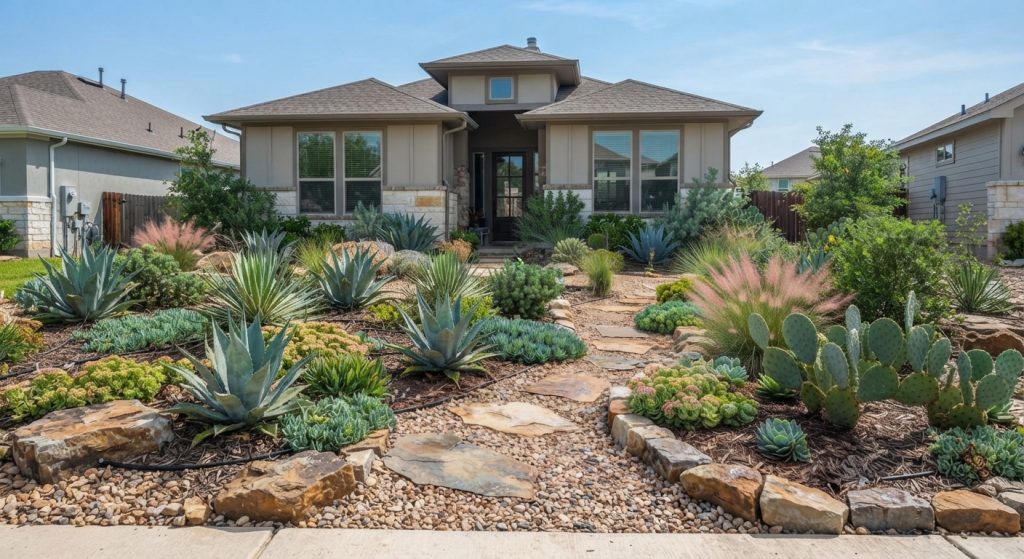
A fully xeriscape yard includes:
- Native plants.
- Drought-tolerant shrubs.
- Native grasses.
- Perennial flowers.
- Ground covers.
- Mulch.
- Decorative rock.
- Paths and patios.
- Small, strategically placed lawn areas.
Remember, the goal should be simple: use water where it is needed. That’s it.
According to Washington State University, xeriscaping is another term for water-wise landscaping and recommends practices such as appropriate plant selection, efficient irrigation, mulching, and limiting unnecessary turf.
How Much Does Xeriscaping Save on Water Bills?
First, let’s talk about how much xeriscaping saves on water bills—which is probably the actual concern of most homeowners.
Actually, the biggest savings come during the hot and dry summer months in Eastern Washington. It’s the time when traditional lawns need frequent watering and when there is less turf to irrigate and more drought-tolerant plants. So, automatically, outdoor water use drops significantly.
According to experts:
- 30–60% less water use in converted areas.
- Potentially thousands of gallons saved each summer.
- Lower water use means a lower monthly bill.
- Savings depend on lawn size and local water rates.
- Efficient irrigation can help you save even more.
What are the Drought-Tolerant Landscaping Benefits?
Drought-tolerant landscaping is probably a great choice for homeowners who want an attractive yard without constant watering and maintenance.
Some benefits are
- Uses significantly less water.
- Helps reduce monthly water bills.
- Requires less frequent watering.
- Needs less mowing and trimming.
- Performs well during dry summers.
- Reduces irrigation maintenance.
- Helps prevent water waste and runoff.
- Supports healthier soil over time.
- Provides habitat for pollinators and wildlife.
- Keeps your landscape attractive with less upkeep.
- Can improve curb appeal.
What are the Costs of Installing Xeriscaping?
Let’s talk about the cost now.
Xeriscaping can save money over time. But installation isn’t free.
You may need to pay for:
- Removing turf.
- Soil preparation.
- Native plants.
- Shrubs.
- Trees.
- Mulch.
- Rock.
- Edging.
- Irrigation changes.
- Drip systems.
- Labor.
- Design.
This means do not expect your new landscape to pay for itself immediately through lower water bills. Instead, think of xeriscaping as a long-term landscape investment.
You’re potentially reducing:
water + mowing + maintenance + irrigation demand
over many years.
How Much Money Can Xeriscaping Save?
Things get a little complicated here.
Unfortunately, water prices are not the same everywhere in Eastern Washington. That’s why the bill may include:
- Water charges.
- Sewer charges.
- Tiered pricing.
- Fixed monthly fees.
- Irrigation-specific rates.
- Seasonal pricing.
Rather than promising that xeriscaping can save you “$…” every year, it’s better to calculate your own savings.
Follow this easy formula:
Gallons saved ÷ 1,000 × your water cost per 1,000 gallons = approximate water-cost savings
For example, xeriscaping saves you
15,000 gallons per summer. Now the effective water cost is $5 per 1,000 gallons
This means your approximate water savings would be 15 × $5 = $75.
If your effective rate is $10 per 1,000 gallons?
That’s $150
The exact number depends on the utility. But remember something important:
The water bill isn’t the only place you can save.
Xeriscaping Can Save More Than Water
Let’s think about everything your traditional lawn requires, and where you might be paying for it:
- Mowing.
- Fertilizer.
- Weed control.
- Aeration.
- Lawn treatments.
- Sprinkler repairs.
- Irrigation maintenance.
- Extra water.
Now compare it with a beautifully designed xeriscape.
You may still have maintenance.
Of course you will.
Plants aren’t magic.
But the maintenance can look very different.
Instead of spending your Sunday morning mowing a lawn, you might spend some time:
- Pulling a few weeds.
- Trimming shrubs.
- Checking irrigation.
- Refreshing mulch.
- Pruning plants.
What Happens After Establishment?
It’s time to see the big difference after establishment. However, your lawn will still need regular watering, especially during hot weather.
Your established xeriscape may need:
- Occasional deep watering.
- Drip irrigation in selected areas.
- Little or no supplemental water for some plants.
- More water during extreme heat.
- Reduce lawn watering costs
- More frequent watering for certain higher-water plants.
Make sure you match irrigation to the plant.
A Simple Way to Estimate Your Own Savings
If you want to estimate your own savings, here is a simple way:
-
Measure Your Lawn
Calculate the approximate square footage of the turf you plan to replace.
-
Estimate Water Use
Check how much water your lawn currently needs during summer.
-
Calculate Potential Savings
Compare your current use with the estimated water needs of xeriscaping.
-
Check Your Water Rate
Use your local utility rate to turn gallons saved into dollars.
Bottom Line—Is Xeriscaping Worth It in Washington?
Yes. Especially if your lawn is huge and you need frequent summer irrigation.
A well-designed xeriscape can potentially reduce irrigation needs by 30–60% in the converted areas, with the exact savings depending on what was there before and what replaces it.
For a larger lawn conversion, that can mean thousands of gallons of water saved during a single summer.
And depending on local water rates, that can translate into meaningful savings on your utility bill too.
Start with that thirsty patch of lawn that doesn’t really do anything.
Your water bill may thank you.
Your Saturday mornings might, too.
Native Plant Landscaping can help you create a beautiful, water-wise landscape designed around Eastern Washington’s climate—not against it.